
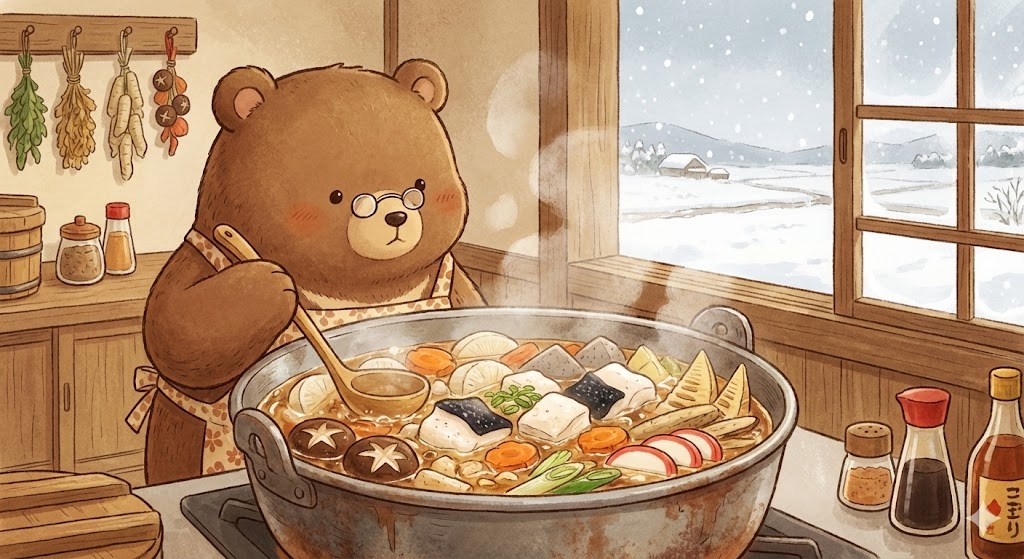
This article is written in English for international readers.
1. Introduction: A Dish That Now Needs Explanation
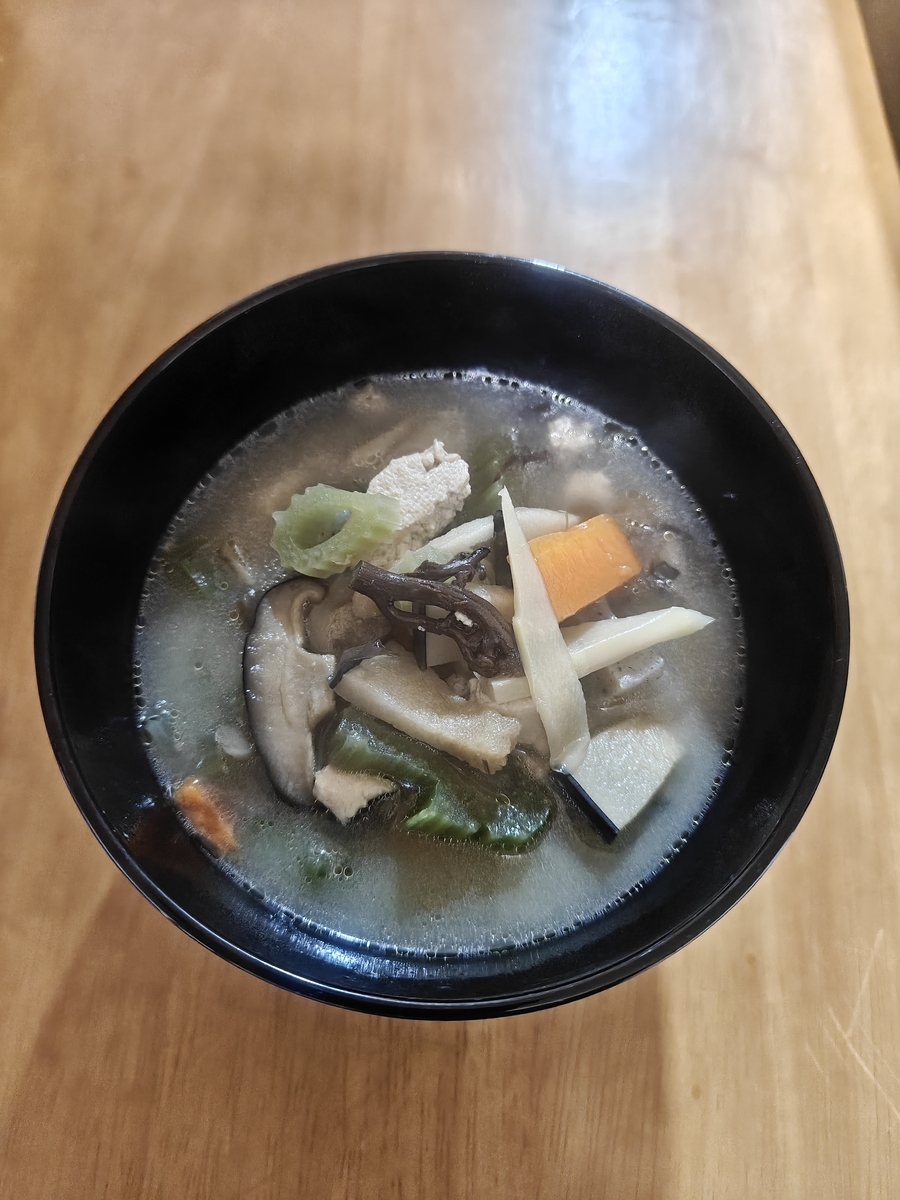
There is a soup called kujira-jiru, or whale soup.
Some people may have heard the name,
but today, fewer and fewer can explain
what kind of dish it is or how it is made.
In my family, kujira-jiru was never considered special food.
Like osechi dishes, it was prepared in large quantities at the end of the year,
then reheated and eaten several times during the New Year holidays.
It was an ordinary, practical soup—part of everyday life.
This article is not meant to present a definitive or authoritative recipe.
Rather, it is a record of how one household actually made kujira-jiru,
and the thinking behind it.
2. About the Region
This version of kujira-jiru comes from households in the Tohoku region
and the southern part of Hokkaido.
The use of spring mountain vegetables, such as nemagaritake (young bamboo shoots),
along with preserved foods, suggests that this soup was not shaped by restaurants
or formal culinary traditions.
It was made with what was available in the kitchen.
Rather than labeling it strictly as a “local specialty,”
it may be more accurate to see kujira-jiru as
one example of a soup that naturally existed
in everyday home cooking in this region.
3. The Role Kujira-jiru Played
Kujira-jiru served a role similar to osechi dishes.
It was cooked in large quantities at the end of the year
to reduce the burden of daily cooking during the New Year holidays.
By simply reheating the pot,
a warm soup with vegetables and fat could be served immediately.
In that sense, kujira-jiru supported the festive “hare” meals of the New Year
by remaining firmly rooted in ordinary daily life—the “ke.”
4. Ingredients (Serves 4, Approximate)
Because this was everyday home cooking, all amounts are approximate.
*Salted whale fat (salt-cured block): about 200g
(The texture is unique—slightly firm yet melting as it is reheated)
Minke whale was commonly used
(Other species have a softer texture and a different mouthfeel.)
*Tofu: 1 block
*Konnyaku: 1 sheet
*Daikon radish: about 300g
*Carrot: about 50g
*Bracken (warabi), salted: about 100g
*Butterbur stalk (fuki), salted: about 50g
(Salted vegetables must be desalinated beforehand.)
*Burdock root: 1/2 root
*Dried shiitake mushrooms: 2
*Nemagaritake (curved young bamboo shoots, often preserved): about 10
*Koya-dofu (freeze-dried tofu): about 50g
*Dashi stock: about 6 cups
*Sake: 1 tablespoon
*Soy sauce: 2 tablespoons
*Salt: to taste
The mix of fresh vegetables, preserved mountain plants, dried foods,
and bottled ingredients reflects seasonal cooking practices—
foods gathered in spring were preserved and used alongside winter vegetables.
5. Method (Guideline)
1) Desalting the Whale
Rinse off surface salt with water.
Cut into pieces approximately 1 cm wide, 2 cm long, and 2 mm thick
Place the whale in cold water and bring to a boil.
After boiling for 1–2 minutes, discard the water.
Repeat this process three times.
2) Preparation
Tear konnyaku into bite-sized pieces using a spoon.
Cut daikon and carrot into thin strips.
Cut bracken into 3 cm lengths.
Shave burdock root.
Slice shiitake thinly.
Slice butterbur into thin rounds.
Rehydrate koya-dofu and slice thinly.
Slice bamboo shoots diagonally into thin pieces.
3) Simmering
Add dashi, prepared vegetables, and whale meat to a pot.
Add tofu by gently crumbling it by hand to allow the flavors to soak in better.
Bring to a simmer and skim off any foam.
4) Seasoning
Season lightly with sake, soy sauce, and salt.
6. Why It Was Made This Way
6-1. Why Whale Fat Was Used
Kujira-jiru uses whale fat rather than lean meat.
There were practical reasons for this:
*Salt-curing made it suitable for long-term storage
*Fat provided valuable calories during winter
*Whale meat was once relatively affordable
*The fat gave a clear sense of warmth when eaten
It was not used because it was luxurious,
but because it was practical.
6-2. When to Add Tofu
Tofu can be added at the beginning or at the end.
There is no deeper meaning to this.
Some households added it early, others later.
That was simply a family-level difference.
6-3. Why the Seasoning Is Mild
The seasoning of kujira-jiru is generally light.
*Dietary preferences shifted toward lower salt over time
*Whale fat provides sufficient depth of flavor
*The soup was reheated multiple times
Repeated reheating naturally concentrates the flavor,
making strong initial seasoning unnecessary.
7. Looking Back Today
Today, whale meat itself has become difficult to obtain.
Even gathering the ingredients requires explanation.
What was once ordinary now needs words.
And yet, when revisiting the method,
kujira-jiru remains a very simple soup.
It was, quite simply,
a soup passed down within everyday life.
8. Reference
Kujira-jiru is also introduced as a regional dish of Hokkaido
in materials published by Japan’s Ministry of Agriculture, Forestry and Fisheries.
(Linked as reference reading.)
www.maff.go.jp
If you are new here, you can explore more beginner-friendly articles in English.
t-kuma.net
Thank you for reading this article.
If you found this article helpful, interesting, or relatable, would you consider supporting my survival and activity?
You can support my survival challenge through two ways:
1. U.S. Amazon Affiliate: If you are outside Japan, or prefer another way to support me, please click my Amazon link below. It doesn't matter what you buy; simply clicking the link and purchasing any item on Amazon helps sustain my life. I will be genuinely grateful for any commission received.
2. Japanese Banner:Please click the support banner below (Japanese ad). Every click contributes approximately one Japanese yen to my necessary living funds.
Purchase on Amazon here (Sorry. Image not displayed)
Crystal Geyser, Alpine Spring Water Natural, 30pk

